Showing posts with label history. Show all posts

Wednesday, March 11, 2009

Photo that may be the last taken of Lincoln emerges

http://doubledoublethoughts.blogspot.com - A photo found in Gen. Ulysses S. Grant's family album is verified to contain an image of Abraham Lincoln. An expert on Lincoln photography thinks a photograph found in Gen. Ulysses S. Grant's family-owned album showing President Abraham Lincoln in front of the White House could be one of the last photos taken of the 16th president before he was assassinated in 1865.

Grant's great-great grandson Ulysses S. Grant VI had seen the previously unpublished image in the general's personal photo album, but didn't think much of it until he scrutinized it earlier this year.

"I started to think that it might be the White House," said Grant, a construction business owner from Springfield, Missouri. "Then I started to look at the height difference between the people in the photo."

Thinking that the towering individual commanding the attention of the other people in the image could be Lincoln -- who stood 6-foot-4 and is the nation's tallest president -- Grant called Keya Morgan, a renowned collector and scholar of Lincoln and Gen. Grant photographs, to see whether his suspicions could be verified.

Morgan, who owns the world's largest collection of Lincoln artifacts and original photographs, persuaded Grant to take the small photo out of the album to see whether any clues could be found on the back -- particularly the name of the photographer.

"If you don't know who the photographer is, it's like not knowing who your father and mother are," Morgan said.

Sure enough, the seal of photographer Henry F. Warren appeared on the back, along with an inscription: "Lincoln in front of the White House," dated 1865. Grant recognized the handwriting as that of his great-grandfather and Gen. Grant's youngest son, Jesse Grant. Those indicators, along with a revenue stamp used from 1864-66 to raise money during the Civil War, helped convince Morgan that the photograph could be the well-documented missing photo from Lincoln's last "sitting."

According to Morgan -- who cites Lincoln's secretaries John Hay and John Nicolay -- Warren took the last three photographs of Lincoln on March 6, 1865, just two days after his second inauguration.

Morgan says Warren was desperate to take pictures of Lincoln, so he staged the first act of paparazzi photography. According to Morgan, Warren first took photos of the president's son Tad on his pony. The following day, Warren gave the pictures to Tad and told him to summon his father. Morgan says that Warren was already set up to take the photo outside the White House, and that Lincoln gave him access afterward to take two more portraits on the White House balcony.

Will Stapp, founding curator of the National Portrait Gallery's photography department and a professional photograph appraiser, agrees with Morgan's assessment of the long-lost image.

"The figure itself, the physique -- in looking at it under a magnifying glass, I can see the shape of his beard; I can see the hairline," Stapp said. "It's similar to the impression you get from other photos taken of [Lincoln] from the same distance, like at the Gettysburg Address and his inauguration."

Stapp and Morgan also say it appears that Lincoln is wearing the same clothes in the outdoor photo as he wore for the portraits taken the same day.

As one of only 130 photographs of Lincoln, it is an extraordinary find not only because of its proximity to Lincoln's death, but because it shows him in a natural stance.

"You could put yourself in the shoes of the people around [Lincoln] and see what it was like to live at the White House," said Morgan, who says he receives 10 to 20 requests a day asking him to verify potential Lincoln photographs.

Morgan, who purchased the photo from Grant, says he has received thousands of e-mails from Lincoln aficionados commenting on the find. His Web site, lincolnimages.com, received more than 5 million hits on Tuesday and crashed because of the traffic overload.

Social Bookmarking

Tuesday, January 20, 2009

Barack Obama Inaugural Address Transcript

Barack Obama has been sworn in as the 44th president of the United States and the nation's first ever African-American president. Here is a complete transcript of his speech.


My fellow citizens:

I stand here today humbled by the task before us, grateful for the trust you have bestowed, mindful of the sacrifices borne by our ancestors. I thank President Bush for his service to our nation, as well as the generosity and cooperation he has shown throughout this transition.

Forty-four Americans have now taken the presidential oath. The words have been spoken during rising tides of prosperity and the still waters of peace. Yet, every so often, the oath is taken amidst gathering clouds and raging storms. At these moments, America has carried on not simply because of the skill or vision of those in high office, but because We the People have remained faithful to the ideals of our forebearers, and true to our founding documents.

So it has been. So it must be with this generation of Americans.

That we are in the midst of crisis is now well understood. Our nation is at war, against a far-reaching network of violence and hatred. Our economy is badly weakened, a consequence of greed and irresponsibility on the part of some, but also our collective failure to make hard choices and prepare the nation for a new age. Homes have been lost; jobs shed; businesses shuttered. Our health care is too costly; our schools fail too many; and each day brings further evidence that the ways we use energy strengthen our adversaries and threaten our planet.

These are the indicators of crisis, subject to data and statistics. Less measurable but no less profound is a sapping of confidence across our land -- a nagging fear that America's decline is inevitable, and that the next generation must lower its sights.

Today I say to you that the challenges we face are real. They are serious and they are many. They will not be met easily or in a short span of time. But know this, America: They will be met.

On this day, we gather because we have chosen hope over fear, unity of purpose over conflict and discord.

On this day, we come to proclaim an end to the petty grievances and false promises, the recriminations and worn-out dogmas, that for far too long have strangled our politics.

We remain a young nation, but in the words of Scripture, the time has come to set aside childish things. The time has come to reaffirm our enduring spirit; to choose our better history; to carry forward that precious gift, that noble idea, passed on from generation to generation: the God-given promise that all are equal, all are free, and all deserve a chance to pursue their full measure of happiness.

In reaffirming the greatness of our nation, we understand that greatness is never a given. It must be earned. Our journey has never been one of shortcuts or settling for less. It has not been the path for the fainthearted -- for those who prefer leisure over work, or seek only the pleasures of riches and fame. Rather, it has been the risk-takers, the doers, the makers of things -- some celebrated, but more often men and women obscure in their labor -- who have carried us up the long, rugged path toward prosperity and freedom.

For us, they packed up their few worldly possessions and traveled across oceans in search of a new life.

For us, they toiled in sweatshops and settled the West; endured the lash of the whip and plowed the hard earth.

For us, they fought and died, in places like Concord and Gettysburg; Normandy and Khe Sahn.

Time and again, these men and women struggled and sacrificed and worked till their hands were raw so that we might live a better life. They saw America as bigger than the sum of our individual ambitions; greater than all the differences of birth or wealth or faction.

This is the journey we continue today. We remain the most prosperous, powerful nation on Earth. Our workers are no less productive than when this crisis began. Our minds are no less inventive, our goods and services no less needed than they were last week or last month or last year. Our capacity remains undiminished. But our time of standing pat, of protecting narrow interests and putting off unpleasant decisions -- that time has surely passed. Starting today, we must pick ourselves up, dust ourselves off, and begin again the work of remaking America.

For everywhere we look, there is work to be done. The state of the economy calls for action, bold and swift, and we will act -- not only to create new jobs, but to lay a new foundation for growth. We will build the roads and bridges, the electric grids and digital lines that feed our commerce and bind us together. We will restore science to its rightful place, and wield technology's wonders to raise health care's quality and lower its cost. We will harness the sun and the winds and the soil to fuel our cars and run our factories. And we will transform our schools and colleges and universities to meet the demands of a new age. All this we can do. And all this we will do.

Now, there are some who question the scale of our ambitions -- who suggest that our system cannot tolerate too many big plans. Their memories are short. For they have forgotten what this country has already done; what free men and women can achieve when imagination is joined to common purpose, and necessity to courage.

What the cynics fail to understand is that the ground has shifted beneath them -- that the stale political arguments that have consumed us for so long no longer apply. The question we ask today is not whether our government is too big or too small, but whether it works -- whether it helps families find jobs at a decent wage, care they can afford, a retirement that is dignified. Where the answer is yes, we intend to move forward. Where the answer is no, programs will end. And those of us who manage the public's dollars will be held to account -- to spend wisely, reform bad habits, and do our business in the light of day -- because only then can we restore the vital trust between a people and their government.

Nor is the question before us whether the market is a force for good or ill. Its power to generate wealth and expand freedom is unmatched, but this crisis has reminded us that without a watchful eye, the market can spin out of control -- and that a nation cannot prosper long when it favors only the prosperous. The success of our economy has always depended not just on the size of our gross domestic product, but on the reach of our prosperity; on our ability to extend opportunity to every willing heart -- not out of charity, but because it is the surest route to our common good.

As for our common defense, we reject as false the choice between our safety and our ideals. Our Founding Fathers, faced with perils we can scarcely imagine, drafted a charter to assure the rule of law and the rights of man, a charter expanded by the blood of generations. Those ideals still light the world, and we will not give them up for expedience's sake. And so to all other peoples and governments who are watching today, from the grandest capitals to the small village where my father was born: Know that America is a friend of each nation and every man, woman and child who seeks a future of peace and dignity, and that we are ready to lead once more.

Recall that earlier generations faced down fascism and communism not just with missiles and tanks, but with sturdy alliances and enduring convictions. They understood that our power alone cannot protect us, nor does it entitle us to do as we please. Instead, they knew that our power grows through its prudent use; our security emanates from the justness of our cause, the force of our example, the tempering qualities of humility and restraint.

We are the keepers of this legacy. Guided by these principles once more, we can meet those new threats that demand even greater effort -- even greater cooperation and understanding between nations. We will begin to responsibly leave Iraq to its people, and forge a hard-earned peace in Afghanistan. With old friends and former foes, we will work tirelessly to lessen the nuclear threat, and roll back the specter of a warming planet. We will not apologize for our way of life, nor will we waver in its defense, and for those who seek to advance their aims by inducing terror and slaughtering innocents, we say to you now that our spirit is stronger and cannot be broken; you cannot outlast us, and we will defeat you.

For we know that our patchwork heritage is a strength, not a weakness. We are a nation of Christians and Muslims, Jews and Hindus -- and nonbelievers. We are shaped by every language and culture, drawn from every end of this Earth; and because we have tasted the bitter swill of civil war and segregation, and emerged from that dark chapter stronger and more united, we cannot help but believe that the old hatreds shall someday pass; that the lines of tribe shall soon dissolve; that as the world grows smaller, our common humanity shall reveal itself; and that America must play its role in ushering in a new era of peace.

To the Muslim world, we seek a new way forward, based on mutual interest and mutual respect. To those leaders around the globe who seek to sow conflict, or blame their society's ills on the West: Know that your people will judge you on what you can build, not what you destroy. To those who cling to power through corruption and deceit and the silencing of dissent, know that you are on the wrong side of history; but that we will extend a hand if you are willing to unclench your fist.

To the people of poor nations, we pledge to work alongside you to make your farms flourish and let clean waters flow; to nourish starved bodies and feed hungry minds. And to those nations like ours that enjoy relative plenty, we say we can no longer afford indifference to suffering outside our borders; nor can we consume the world's resources without regard to effect. For the world has changed, and we must change with it.

As we consider the road that unfolds before us, we remember with humble gratitude those brave Americans who, at this very hour, patrol far-off deserts and distant mountains. They have something to tell us today, just as the fallen heroes who lie in Arlington whisper through the ages. We honor them not only because they are guardians of our liberty, but because they embody the spirit of service; a willingness to find meaning in something greater than themselves. And yet, at this moment -- a moment that will define a generation -- it is precisely this spirit that must inhabit us all.

For as much as government can do and must do, it is ultimately the faith and determination of the American people upon which this nation relies. It is the kindness to take in a stranger when the levees break, the selflessness of workers who would rather cut their hours than see a friend lose their job which sees us through our darkest hours. It is the firefighter's courage to storm a stairway filled with smoke, but also a parent's willingness to nurture a child, that finally decides our fate.

Our challenges may be new. The instruments with which we meet them may be new. But those values upon which our success depends -- hard work and honesty, courage and fair play, tolerance and curiosity, loyalty and patriotism -- these things are old. These things are true. They have been the quiet force of progress throughout our history. What is demanded then is a return to these truths. What is required of us now is a new era of responsibility -- a recognition, on the part of every American, that we have duties to ourselves, our nation and the world; duties that we do not grudgingly accept but rather seize gladly, firm in the knowledge that there is nothing so satisfying to the spirit, so defining of our character, than giving our all to a difficult task.

This is the price and the promise of citizenship.

This is the source of our confidence -- the knowledge that God calls on us to shape an uncertain destiny.

This is the meaning of our liberty and our creed -- why men and women and children of every race and every faith can join in celebration across this magnificent Mall, and why a man whose father less than 60 years ago might not have been served at a local restaurant can now stand before you to take a most sacred oath.

So let us mark this day with remembrance, of who we are and how far we have traveled. In the year of America's birth, in the coldest of months, a small band of patriots huddled by dying campfires on the shores of an icy river. The capital was abandoned. The enemy was advancing. The snow was stained with blood. At a moment when the outcome of our revolution was most in doubt, the father of our nation ordered these words be read to the people:

"Let it be told to the future world ... that in the depth of winter, when nothing but hope and virtue could survive... that the city and the country, alarmed at one common danger, came forth to meet [it]."

America. In the face of our common dangers, in this winter of our hardship, let us remember these timeless words. With hope and virtue, let us brave once more the icy currents, and endure what storms may come. Let it be said by our children's children that when we were tested, we refused to let this journey end, that we did not turn back, nor did we falter; and with eyes fixed on the horizon and God's grace upon us, we carried forth that great gift of freedom and delivered it safely to future generations.

President Obama steps into history, and a world of peril

http://doubledoublethoughts.blogspot.com - President Barack Obama Tracing the arc of history to a day many thought would never come, Barack Obama will be sworn in as America's 44th and first black president -- and wades into a sea of troubles.

Climaxing the unlikeliest of journeys, Barack Obama, the son of a black Kenyan and white mother from Kansas will be taking the oath of office at noon (1700 GMT) on the steps of the Capitol, a congressional building built by slave labor.

Guarded by an unprecedented security operation, millions were expected to pack the National Mall stretching from Capitol Hill to the Lincoln Memorial, where Martin Luther King, Jr. in 1963, spoke of a dream of racial unity.

To his successor, outgoing President George W. Bush bequeaths an economy in crisis, a war on two fronts and a patchwork of frayed alliances. For Barack Obama, drawing inspiration both from former great Presidents Abraham Lincoln and Franklin D. Roosevelt, the perils of the age call for a spirit of national sacrifice unseen since World War II.

"Tomorrow, we will come together as one people on the same mall where Dr. King's dream echoes still," Obama said Monday, paying tribute to the slain civil rights hero on the national holiday commemorating King's birth.

"As we do, we recognize that here in America, our destinies are inextricably linked," he said.

"We resolve that as we walk, we must walk together. And as we go forward in the work of renewing the promise of this nation, let's remember King's lesson -- that our separate dreams are really one."

Tuesday morning, in the first presidential handover since the September 11 attacks of 2001, Barack Obama and his wife Michelle were to meet the departing president and First Lady Laura Bush at their new home in the White House.

Then, after swearing to "preserve, protect and defend" the US constitution, Obama is to deliver his most important speech yet in a career littered with memorable oratory since his explosion onto the national stage in 2004.

Braving the cold, a vast crowd was expected to line the Mall, watching the historic inauguration either near the West Front of the US Capitol for the lucky few, or in front of giant television screens for the rest.

Renita King, 46, said she had flown from Houston, Texas with her six-year-old son Arthur to mark the years of racial prejudice endured by her 73-year-old mother.

"I am here for her, and every time that she was called a n*gger -- that is how I see this, as an American," she said.

Aides said Obama's call for all Americans to embrace public service would dominate his inaugural address, as he gets to grips with the nation's longest recession since World War II and his plans to pull US troops out of Iraq.

"Given the crisis we're in and the hardships so many people are going through, we can't allow any idle hands. Everybody's going to have to be involved. Everybody's going to have to pitch in," Obama said during a visit Monday to a teen shelter in Washington.

The "war on terror" is just one part of Obama's groaning in-tray of challenges.
From Gaza to Guantanamo, he confronts a world in tumult, a point underscored by the latest bellicose noises from nuclear-armed North Korea.

Following the inauguration of President Barack Obama and vice president-elect Joseph Biden, the new US leaders were to lunch with members of Congress, Supreme Court justices and Obama's cabinet, including secretary of state Hillary Clinton.

Marching bands, military veterans, union workers and schoolchildren were to then join a parade down Pennsylvania Avenue to the White House for President Obama to take up the reins of power in the Oval Office.... and his place in history.

Outgoing Vice President Dick Cheney, 67, who pulled a muscle in his back Monday -- the latest in a series of health problems -- while moving boxes and will be in a wheelchair for the inauguration, the White House said.

The whirlwind day is to end with 10 official inaugural balls before the Obama's could retire with their daughters Malia and Sasha, becoming the youngest First Family since that of John F. Kennedy, who occupied the White House in the early 1960s.

The celebrations have an acute poignancy for many in the United States, and the world, given Obama's mold-shattering bi-racial heritage.

Even tennis star Serena Williams, a Jehovah's Witness who makes a point of staying out of political matters, said from the Australian Open that she was inspired by Obama.

"This is an amazing moment for American history," she said.

Can the rest of the world be excited about the new presidency? Yes we can!

Sunday, January 18, 2009

Illinois man selling Obama's old Chrysler 300C

A luxury Chrysler sedan that president-elect Barack Obama drove before winning the White House is being auctioned off on eBay.

The starting bid is $100,000.

Tim O'Boyle, the general manager of a restaurant in Hillside, Ill., west of Chicago, is selling Obama's steel-blue 2005 Chrysler 300C Hemi on the Internet auction site, hoping to cash in on history.
The price is a cool $1 million under eBay's ``Buy It Now'' option.

"In my mind, it's a one-of-a-kind car," O'Boyle said Wednesday.

Obama leased the car in 2004 at Park Plaza Dodge in Forest Park, Ill., and swapped it for a Ford Escape Hybrid in 2007.

The vehicle was transferred back to the dealership, where O'Boyle bought it used last February.
Before driving off, "one of the guys over at the car dealership said: `You better hold onto that thing,''' said O'Boyle, an Obama supporter.
I said: "Why's that?" and he said: "Because it used to belong to Obama."

Gary Hall, finance director for Park Plaza Dodge, confirmed Obama had leased the car from the dealership and O'Boyle later bought the vehicle.

O'Boyle tried to sell it on eBay in December but stopped the bidding process when his accountant told him to wait until he had owned it for a year for tax reasons.
O'Boyle said the top bid on eBay was $125,100 and another person contacted him offering $150,000.

Anything near that amount would be a coup. Kelley's Blue Book values a 2005 Chrysler 300C in excellent condition at $15,750. A 2009 300C has a list price of $27,415 but sales of the car took a nosedive in 2008.
Chrysler LLC sold 62,352 300C sedans last year, a 48-per-cent decline over the previous year.
O'Boyle reasoned cars used by ther late pope John Paul II and late U.S. president John Kennedy have sold at auctions for tens of thousands of dollars. He said some of the proceeds will benefit the Italian American Executives of Transportation, a Chicago-area charity.
The restaurateur hopes the bids surpass previous offers but he's not tipping his hand.
"I've got a number in my head and I'm not going to tell you what it is,'' O'Boyle said.
"If I can't get what I'm after, I'm not really interested in selling it.''

The car comes "loaded'' with a navigation system, a sunroof and leather interior, the eBay listing says. Obama and O'Boyle only logged a combined 33,475 kilometres and the sedan is still under warranty.

"Overall, the car is immaculate. If you were to jump inside the thing and drive it, you'd think you're driving a brand new car,'' O'Boyle said.
"Hopefully, he takes as good care of the country as he did the car.''

Monday, January 5, 2009

German battlefield yields Roman surprises


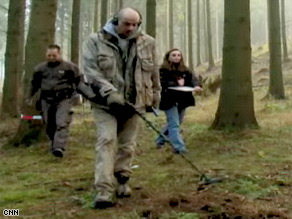
http://doubledoublethoughts.blogspot.com - Researchers say the evidence suggests the tribesmen lured the Romans into forest.Archaeologists have found more than 600 relics from a huge battle between a Roman army and Barbarians dating back to the third century, long after historians believed Rome had given up control of northern Germany.

"We have to write our history books new, because what we thought was that the activities of the Romans ended at nine or 10 (years) after Christ," said Lutz Stratmann, science minister for the German state of Lower Saxony. "Now we know that it must be 200 or 250 after that."

For weeks, archeologist Petra Loenne and her team have been searching this area with metal detectors, pulling hundreds of ancient Roman weapons out of the ground. They paint a picture of a highly organized, technologically superior Roman army beset by Germanic tribes in a forest about 80 km (50 miles) south of the modern city of Hanover.

The hillside battlefield was discovered by relic-hunters that were illegally searching for souvenirs of more recent wars near the town of Kalefeld-Oldenrode. One of them brought some of the items he found to Loenne, who works for the local government.

The artifacts are so well preserved that the scientists can already retrace some of the battle lines.

"We believe the Germans ambushed the Romans here, but the legions quickly fired back with catapults and archers -- and then it came to a massive man-on-man onslaught," Loenne said.

The items unearthed so far include an axe, still sharp after nearly 1,800 years; horseshoes; shovels; spearheads; and dozens of arrowheads for a Scorpio, a cross between a catapult and a crossbow -- the ancient equivalent of artillery.

"With a very high speed, on a very long distance -- about 300 meters -- you can hit targets precisely," said Henning Hassman, of Hanover's archeological institute.

Researchers say the evidence suggests the tribesmen lured the Romans into the forest to keep them from making full use of those long-range weapons and draw them into hand-to-hand combat, outside of the formations the imperial troops had mastered. However, they believe the Romans ultimately prevailed.

Other relics include coins depicting the late second-century Roman emperor Commodus, depicted in the Oscar-winning Hollywood epic "Gladiator" -- a film that opens with a scene of battle against a barbarian horde that scientists say appears to be largely accurate. Loenne said her team may have only begun to scratch the surface of the forest.

"We hope we might find fortifications and if we are lucky, maybe even battlefield graveyards," she said.

Tuesday, December 30, 2008

Happy Kwanzaa!!


10 Things you didn't know about Kwanzaa

Kwanzaa was conceived in 1966 by Maulana Karenga, who launched the holiday in the midst of the Black Power Movement and a year after the Watts riots tore open the wounds of racial division in Los Angeles. (Karenga later served time in prison in an assault case related to his opposition to the Black Panthers. After being released from prison, Karenga became an Africana studies professor at California State University at Long Beach.) According to The Complete Kwanzaa by Dorothy Winbush Riley, Karenga said he started Kwanzaa as "a necessary minimum set of principles by which Black people must live in order to begin to rescue and reconstruct our history and lives." The holiday is celebrated from Dec. 26-Jan. 1 every year. Estimates about the number of Americans who celebrate Kwanzaa vary widely, with some figures in the millions.

First Fruits
Kwanzaa is not a religious holiday. It is a cultural holiday based on African harvest festivals and the word "Kwanzaa" is based on a Swahili phrase "matunda ya kwanza" (“first fruits”). It's most popular among African Americans, but has also been embraced by black Caribbeans and other subsets of the African diaspora as a way to celebrate Pan-African history and encourage pride in the black community.


Seven Principles
The celebration of Kwanzaa is organized around the number 7. There are Seven Principles of Kwanzaa, each celebrated on a different day. The principles, in order, are unity, self-determination, collective work and responsibility, cooperative economics, purpose, creativity, faith. There are also seven symbols: fruits/nuts/vegetables, place mats, ears of corn, candles, candle holders, communal cups, and gifts. These seven symbols are arranged on a table at the beginning of Kwanzaa. On each day, members of celebrating households gather together to discuss the principles and sometimes read poems or perform music or dance.


On the Calendar
By the 1990s, Kwanzaa was being celebrated alongside Christmas and Hanukkah as a mainstream national holiday, with Hallmark creating Kwanzaa cards and the U.S. Postal Service introducing an official Kwanzaa stamp in 1997. The stamp has been reissued in various denominations four times.


"What's Up?" Swahili Style

Each day of Kwanzaa, participants greet each other with the phrase "Habari Gani", which translates to "What's the News?" in Swahili. The answer, that day’s Kwanzaa Principle.


It's the thought that counts
Expensive gift giving is not a major tenet of the holiday. Although the seventh symbol of Kwanzaa is "gifts," exchanges mostly happen between immediate family members, and often include handmade gifts or books that celebrate African culture. According to The Complete Kwanzaa, the purpose of this modest gift giving is "to avoid the chaos of shopping and conspicuous consumption during the December holiday season."


Colorful symbols
The official colors of Kwanzaa are red, symbolizing the struggles of the African people; black, symbolizing Earth and the African people; and green, symbolizing hope and the future. The Kwanzaa candles are arranged in a holder with a black candle in the middle and red and green candles on the sides. One candle is lit each day of Kwanzaa.


Merry Christmas Kwanzaa
Kwanzaa and other December holidays, including Christmas, are not mutually exclusive. Kwanzaa's official edicts say that it was specifically created as a cultural, and not a religious, holiday, although the holiday's official web site states that "one can accept and revere the religious message and meaning [of Christmas] but reject its European cultural accretions of Santa Claus, reindeer, mistletoe, frantic shopping, alienated gift-giving, etc." Most early practitioners of Kwanzaa did not celebrate Christmas, but the division between the two holidays has faded in recent decade.


A Marketing Opportunity
Despite its organizers' best efforts, Kwanzaa has verged into commercialized territory long occupied by Christmas, with annual marketing campaigns geared specifically for the Kwanzaa holiday. Every year, various "Kwanzaa Expos" are held in cities all over the country. Dancers and musicians perform at the events, while vendors sell Kwanzaa and African-related merchandise.


Fit For A Poet
In 2008, Maya Angelou narrated a documentary called The Black Candle, the first full-length film to be made about Kwanzaa. Directed by M.K. Asante, Jr., the film includes interviews with rapper Chuck D., Kwanzaa founder Maulana Karenga, and NFL star Jim Brown.


HAPPY NEW YEAR!!!!!


Well it's another year....

But for what reason??


"Happy New Year!" That greeting will be said and heard for at least the first couple of weeks as a new year gets under way.

But the day celebrated as New Year's Day
in modern America was not always on January 1st.

ANCIENT NEW YEARS The celebration of the new year is the oldest of all holidays. It was first observed in ancient Babylon approximately 4000 years ago. In the years around 2000 BC, the Babylonian New Year began with the first New Moon (actually the first visible cresent) after the Vernal Equinox (first day of spring).

The beginning of spring is a pretty logical time to start a new year.
After all, it is the season of rebirth, of planting new crops, and of blossoming. January 1, on the other hand, has no astronomical nor agricultural significance. It is purely arbitrary.

The Babylonian new year celebration lasted for eleven days. Each day had its own particular mode of celebration, It's safe to say that modern New Year's Eve festivities pale in comparison.

The Romans continued to observe the new year in late March, but their calendar was continually tampered with by various emperors so that the calendar soon became out of synchronization with the sun.

In order to set the calendar right, in 153 BC, the Roman senate, declared January 1 to be the beginning of the new year. But tampering continued until Julius Caesar, in 46 BC, established what has come to be known as the Julian Calendar. It again established January 1 as the new year. But in order to synchronize the calendar with the sun, Caesar had to let the previous year drag on for 445 days.

THE CHURCH'S VIEW OF NEW YEAR CELEBRATIONS
Although in the first centuries AD the Romans continued celebrating the new year, the early Catholic Church condemned the festivities as paganism. But as Christianity became more widespread, the early church began having its own religious observances concurrently with many of the pagan celebrations, and New Year's Day was no different. New Years is still observed as the Feast of Christ's Circumcision by some denominations.

During the Middle Ages, the Church remained opposed to celebrating New Years.
January 1 has been celebrated as a holiday by Western nations for only the past 400 years (give or take).


NEW YEAR TRADITIONS
Other traditions of the season include the making of New Year's resolutions.

That tradition also dates back to the early Babylonians. Popular modern resolutions might include the promise to lose weight or quit smoking. The early Babylonian's most popular resolution was to return borrowed farm equipment to there rightful owners.


The Tournament of Roses Parade, dates back to 1886. In that year, members of the Valley Hunt Club decorated their carriages with flowers. It celebrated the ripening of the orange crop in California.

Although the Rose Bowl football game was first played as a part of the Tournament of Roses in 1902, it was replaced by Roman chariot races the following year. In 1916, the football game returned as the sports centerpiece of the festival.


The tradition of using a baby to signify the new year was begun in Greece around 600 BC. It was their tradition at that time to celebrate their god of wine, Dionysus, by parading a baby in a basket, representing the annual rebirth of that god as the spirit of fertility. Early Egyptians also used a baby as a symbol of rebirth.

Although the early Christians denounced the practice as pagan, the popularity of the baby as a symbol of rebirth forced the Church to re-evaluate its position. The Church finally allowed its members to celebrate the new year with a baby, which was to symbolize the birth of the baby Jesus.


The use of an image of a baby with a New Years banner as a symbolic representation of the new year was brought to early America by the Germans.
They had used the effigy since the fourteenth century.

FOR LUCK IN THE NEW YEAR
Traditionally, it was thought that one could affect the luck they would have throughout the coming year by what they did or ate on the first day of the year. For that reason, it has become common for folks to celebrate the first few minutes of a brand new year in the company of family and friends.

Parties often last into the middle of the night after the ringing in of a new year. It was once believed that the first visitor on New Year's Day would bring either good luck or bad luck the rest of the year. It was particularly lucky if that visitor happened to be a tall dark-haired man.

Traditional New Year foods are also thought to bring luck. Many cultures believe that anything in the shape of a ring is good luck, because it symbolizes "coming full circle," completing a year's cycle. For that reason, the Dutch believe that eating donuts on New Year's Day will bring good fortune.

Many parts of the U.S. celebrate the new year by consuming black-eyed peas. These legumes are typically accompanied by either hog jowls or ham. Black-eyed peas and other legumes have been considered good luck in many cultures. The hog, and thus its meat, is considered lucky because it symbolizes prosperity. Cabbage is another "good luck" vegetable that is consumed on New Year's Day by many. Cabbage leaves are also considered a sign of prosperity, being representative of paper currency. In some regions, rice is a lucky food that is eaten on New Year's Day.

AULD LANG SYNE
The song, "Auld Lang Syne," playing in the background, is sung at the stroke of midnight in almost every English-speaking country in the world to bring in the new year.
At least partially written by Robert Burns in the 1700's, it was first published in 1796 after Burns' death. Early variations of the song were sung prior to 1700 and inspired Burns to produce the modern rendition. An old Scotch tune, "Auld Lang Syne" literally means "old long ago," or simply, "the good old days." Can't remember the words? The lyrics can be found here.